
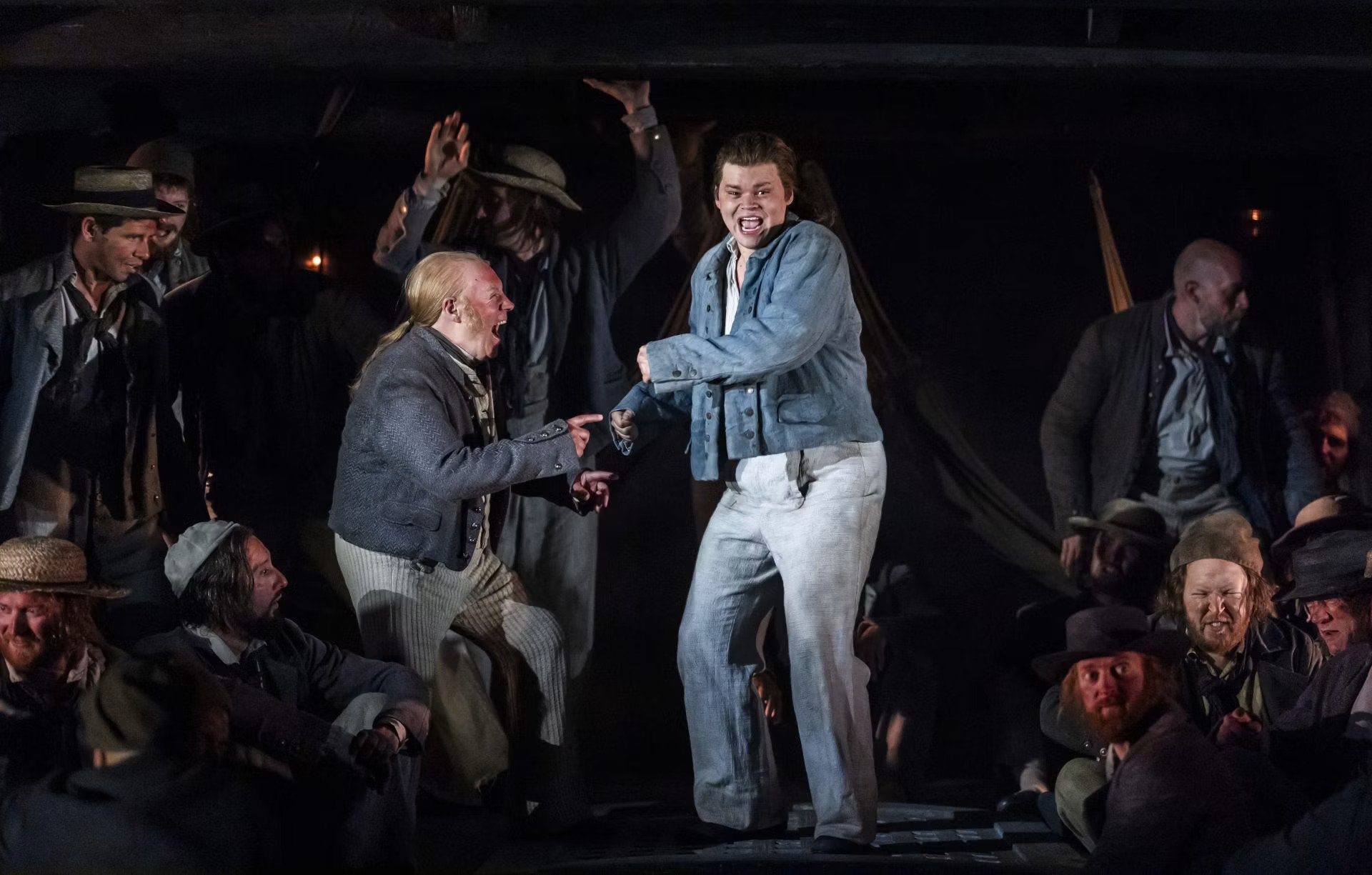
Billy Budd Glyndebourne 2026 ©Tristram Kenton
A further revival of Michael Grandage’s 2010 outstanding production of Billy Budd with sets by Christopher Oram takes us into the frame of the battleship HMS Indomitable, a British man of war during the French wars of 1797. We are never on deck but only ever in the claustrophobic atmosphere below with exceptional attention to detail in the creation of a ship of that period. But the strength of this revival lay in the remarkable consistency of the ensemble. It was spectacular in the second act watching the action when an enemy ship was sighted and chased. All the elements of the warships crew are seen in action, and a huge Red Ensign is seen fluttering in the breeze at the stern. The incredible atmosphere of the preparation for battle was thrilling.
Thomas Mole's Billy Budd was a genuine star-making performance. There was an effortless openness to both his singing and acting that made it impossible not to warm to him from his very first entrance. His handsome, lyric baritone has an attractive bloom throughout the range, never forced, never manufactured, simply sung with disarming honesty. Mole avoided portraying Billy as merely naïve; instead, he gave us a young man whose goodness is so instinctive that deceit simply never occurs to him. His inability to articulate himself when accused became genuinely painful to watch. His final "Billy in the Darbies" was beautifully judged, sung with simplicity rather than sentimentality, leaving the sympathetic audience utterly captivated.
Allan Clayton once again demonstrated why he remains one of the world's finest interpreters of Britten. Captain Vere can often become emotionally remote, but Clayton created a man visibly ageing before our eyes as every decision tightened the moral noose around his own neck. Vocally he was in glorious form. His tenor retains its unmistakable brightness while now carrying an added warmth and authority that perfectly suits this conflicted commander. Every word mattered. Britten's intricate text emerged with crystalline clarity, and Clayton's extraordinary ability to colour individual phrases made Vere's internal torment almost unbearable. His Epilogue was devastating, quiet, haunted and utterly unforgettable.
As Claggart, Sam Carl produced one of the most unsettling performances of the evening. Rather than portraying evil as something overtly theatrical, Carl found something infinitely more disturbing—a man consumed by corrosive self-hatred. His bass-baritone possesses impressive depth and resonance, but it was his psychological insight that impressed most. Every movement was calculated, every stare unsettling. His "O beauty, O handsomeness, goodness!" became less an aria of admiration than a terrifying confession of obsession. The confrontation with Billy crackled with tension long before a note was sung.
Clive Bayley brought immense dignity to Dansker. His rich, weathered bass carried the authority of experience, and his understated humanity provided one of the few moments of genuine warmth aboard the Indomitable. Bayley has the invaluable ability to dominate a scene simply through presence, and every appearance felt completely authentic.
The many other parts were well sung. Laurence Kilsby gave one of the evening's most affecting performances as the Novice. The flogging scene was almost unbearable, and Kilsby conveyed fear and humiliation without ever overplaying the emotion. His interactions with Billy underlined the latter's instinctive compassion.
William Thomas was an imposing Mr Flint and alongside him, Dingle Yandell's Mr Redburn positively relished the ship's harsh military code, creating an effective contrast between bureaucracy and outright brutality.
Daniel Okulitch made an intelligent and sharply observed Lieutenant Ratcliffe, balancing naval professionalism with an awareness of the moral catastrophe unfolding around him. Michael Wallace and John Mackenzie-Lavansch were excellent as the First and Second Mates respectively, both contributing strongly to the sense of a fully functioning naval command rather than simply serving as anonymous officers.
And among the sailors, Samuel Dale Johnson's Donald was vividly characterised, while Daniel Norman's Squeak emerged as suitably unpleasant without descending into caricature. Glyndebourne has long specialised in casting every role with care, and Billy Budd demonstrated precisely why that philosophy continues to pay dividends.
The Glyndebourne Chorus deserves particular praise. Britten gives the sailors music of extraordinary complexity, requiring not only immaculate ensemble but complete dramatic conviction. Here they excelled on both counts. Whether hauling ropes, scrubbing decks, preparing for battle or witnessing Billy's execution, they never ceased to be believable members of a living, breathing crew. Their cries of "Billy Budd! Billy Budd!" after the execution echoed around the theatre with overwhelming emotional force.
In the pit, Nicholas Carter conducted with complete command of Britten's vast score. He understood that Billy Budd thrives on tension rather than sheer volume. The London Philharmonic Orchestra responded magnificently, from the shimmering sea interludes to the terrifying orchestral eruptions surrounding the accusation scene. Carter allowed Britten's extraordinary orchestration to breathe, finding lyricism where others seek only drama and ensuring the score retained its inexorable momentum over nearly three hours.
This was ensemble opera-making of the very highest order—exactly the sort of performance Glyndebourne has built its reputation upon for generations. No weak links, no passengers, simply a company of artists serving Britten's masterpiece with intelligence, commitment and extraordinary musical excellence.
David Buchler, Opera Spy
