
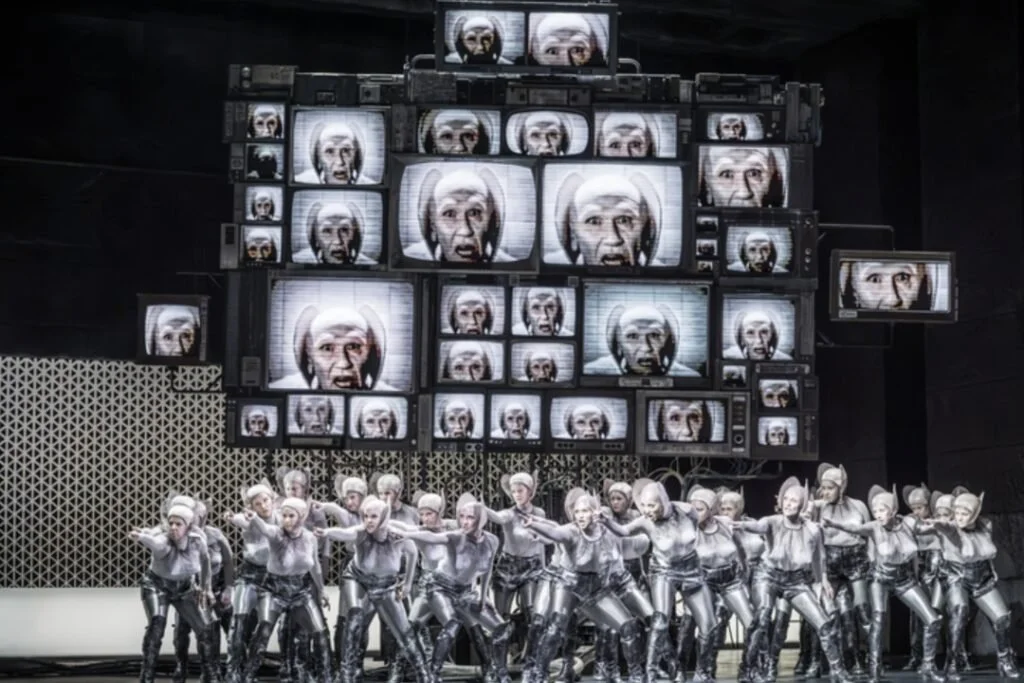
Parsifal Royal Ballet and Opera 2026 ©Marc Brenner
Wagner’s Parsifal is hardly short of opportunities for solemnity. Five and a half hours of redemption, suffering, compassion, the Holy Grail and Wagner’s particular brand of metaphysical introspection can test even the most committed Wagnerian. The challenge, therefore, for any new production is to find something fresh to say without suffocating the music beneath a layer of directorial earnestness.
Evgeny Titov’s new production at Covent Garden certainly has something to say. Whether one wants to hear it is another matter.
This is Parsifal transplanted from its familiar medieval-Grail setting into a grim, claustrophobic dystopia. Étienne Pluss’s set resembles a subterranean bunker or religious prison, complete with concrete, surveillance cameras and an oppressive sense that the Grail community has long since ceased to be a community of the redeemed. It is a world of damaged men, institutionalised violence and religious ritual stripped of comfort.
It is, in other words, emphatically not a conventional Parsifal.
And yet, rather surprisingly, much of the evening’s success comes not from the staging but from the musical performance, where Jakub Hrůša and the Orchestra of the Royal Opera House provide a compelling justification for the long journey.
Hrůša conducts with patience but without inertia. The score breathes, unfolds and accumulates rather than simply being allowed to wallow. There is considerable attention to Wagner’s orchestral detail, with the strings providing an extraordinary warmth beneath the darker colours of the brass and lower woodwind. The transformation music in particular has the sense of something genuinely unfolding rather than being treated as the obligatory opportunity for the conductor to demonstrate how slowly he can take Wagner.
The Royal Ballet and Opera Chorus is also excellent. The Grail knights have rarely sounded so much like a community that has suffered a collective trauma. There is weight and sonority, but also an impressive discipline to the ensemble singing.
At the centre of the performance is Stanislas de Barbeyrac, whose Parsifal develops convincingly from callow innocence to something approaching spiritual authority. His tenor is ideally suited to the role: bright without being brittle, muscular without forcing, and capable of considerable tenderness. He is particularly impressive in Act II, where the vocal line has to survive both Wagner’s writing and Titov’s rather unforgiving stage direction. De Barbeyrac manages to make Parsifal's gradual awakening believable without turning him into a cardboard saint.
Christian Gerhaher is an Amfortas of extraordinary intensity. This is a role that can easily become a prolonged exercise in noble suffering, but Gerhaher gives the wounded Grail king a genuine psychological complexity. His singing is beautifully controlled, the words exceptionally clear, and the sense of physical and emotional exhaustion palpable. His Amfortas is not merely in pain; he is trapped by the very institution that requires him to continue suffering for the benefit of everyone else.
The contrast with Ekaterina Gubanova’s Kundry is particularly effective. Gubanova gives a formidable performance, vocally and dramatically. Her mezzo has the necessary darkness and authority, but there is also a remarkable vulnerability beneath the character’s ferocity. In Act II she is genuinely dangerous, seductive and ultimately tragic. Her confrontation with Parsifal becomes one of the evening’s most compelling episodes, and Gubanova makes Kundry considerably more than the traditional Wagnerian femme fatale.
Brindley Sherratt brings the experience and authority one hopes for from Gurnemanz. His bass remains impressively firm and resonant, although it somewhat tired in the last Act. He negotiates the enormous amount of text with intelligence and clarity. More importantly, there is humanity in the performance. Gurnemanz is not simply Wagner’s narrator; Sherratt makes him a man who has witnessed the collapse of the world in which he once believed.
Mark Stone’s Klingsor is an altogether different proposition. Titov presents him with a distinctly uncomfortable mixture of grotesquerie and authoritarian absurdity, and Stone - dressed in a shiny suit - throws himself into it with considerable relish. Outstanding vocally, he has plenty of power and presence, and his exchanges with Kundry and Parsifal generate real theatrical electricity.
James Platt makes a strong impression as Titurel, while the younger members of the cast make the most of their smaller contributions. The Flowermaidens – Chelsea Zurflüh, Rhian Lois, Sarah Richmond, Sarah Brady, Marianna Hovanisyan and Ellen Pearson – sing with impressive ensemble precision, even if Titov's treatment of them is deliberately far removed from the usual sensual fantasy of Klingsor's garden.
And therein lies the central problem.
Titov's production is undoubtedly imaginative, visually accomplished and committed to its own argument. But there are moments when one wonders whether the director trusts Wagner sufficiently to allow the music to make the argument for him.
The Christian imagery is deliberately dismantled, the Grail community is presented as deeply corrupt, and the idea of redemption becomes increasingly ambiguous. There is considerable violence and some genuinely disturbing stage business. The production's most provocative moments are clearly designed to challenge the audience rather than reassure it.
That is entirely legitimate. Parsifal has always invited argument.
But provocation is not automatically profundity. There are times when Titov's ideas seem to arrive before the music has had an opportunity to speak, and the visual assault can become exhausting. Wagner gives us one of opera's great journeys from darkness towards light; Titov appears rather more interested in asking whether there was ever any light in the first place.
Fortunately, whenever the stage threatens to overwhelm the work, the orchestra pulls us back into Wagner's extraordinary musical world.
The final act is especially impressive. Hrůša allows the music to gather its extraordinary sense of inevitability, and the combination of orchestral playing and singing produces some of the evening's most affecting moments. Gerhaher's Amfortas remains painfully human, while de Barbeyrac's Parsifal has finally acquired the authority that seemed so remote at the beginning.
What happens next, of course, depends on how one responds to Titov's final vision. There is no Holy Grail, and the community disappears from the stage in a grotesque physically challenged rabble. Certainly not the ending that Wagner wrote. There was audible division in the auditorium, with cheers competing with loud boos. That is perhaps inevitable with a production as uncompromising as this.
But if the measure of a Parsifal is whether it makes you think, listen and argue on the journey home, this one certainly succeeds.
The production may not persuade everyone. It certainly did not persuade me of everything it attempts to say. But musically this is a formidable evening: Hrůša conducts with intelligence and imagination, the Royal Opera Orchestra plays magnificently, the chorus is outstanding, and the principal cast – particularly de Barbeyrac, Gerhaher, Gubanova and Sherratt – gives the performance considerable vocal and dramatic authority.
Five and a half hours may be a long time to spend in Titov's bunker.
Fortunately, Wagner is there to let us out.
David Buchler, Opera Spy
