
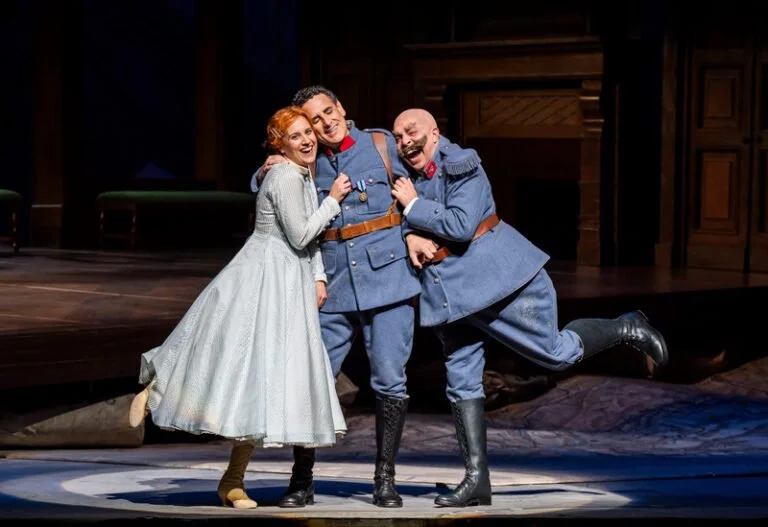
La Fille du régiment Royal Ballet and Opera 2026 ©Tristram Kenton
There are productions that improve with age, and then there is Laurent Pelly's La Fille du régiment – now approaching the status of a cherished family heirloom, polished to perfection with every revival. Nearly twenty years after it first stormed Covent Garden, it remains as irresistibly funny as ever, proving that genuine theatrical wit has a much longer shelf life than fashionable directorial gimmickry.
The audience arrived expecting Donizetti's fizzing comedy; they left reminded why this production has become one of the Royal Opera's modern classics. Pelly understands that comedy in opera is all about precision. Every salute, stumble, potato sack and military manoeuvre lands with split-second timing, while the jokes never distract from the surprisingly touching heart beating beneath the farce.
Visually, Pelly's designs continue to charm. Chantal Thomas's ingenious Alpine setting remains wonderfully theatrical, and the oversized maps and military paraphernalia create a world that is simultaneously cartoonish and affectionate. Laura Scozzi's choreography still injects the ensemble scenes with infectious momentum, while Dan Dooner's revival direction keeps every comic mechanism running with military precision.
The Canadian Yves Abel, who knows this score almost instinctively, conducted with affectionate energy. He allowed Donizetti's melodies to sparkle without ever rushing them, giving the Orchestra of the Royal Opera House every opportunity to relish the score's elegance and rhythmic vitality. The overture danced rather than marched, and throughout the evening the orchestra supported rather than competed with the singers—a lesson some conductors could do well to remember.
Catalan soprano Sara Blanch, made a sensational Royal Opera debut as Marie. She possesses exactly the combination this impossible role demands: fearless coloratura, impeccable comic timing and a warmth that prevents the heroine becoming merely a hyperactive tomboy. From her first entrance she dominated the stage with infectious charisma, tossing off Donizetti's vocal fireworks with astonishing ease while making every spoken exchange feel spontaneous. Her Act II music, in particular, revealed an emotional depth that caught the audience delightfully off guard. Here was not simply an athletic soprano, but a genuine singing actress.
Juan Diego Flórez, the Peruvian operatic tenor, returned to one of his signature roles as Tonio, reminding us why he has become almost synonymous with the lovestruck Tyrolean. Time may have added a little more warmth and colour to the voice, but the effortless elegance of his singing remains intact. His celebrated "Ah! mes amis" was everything the Covent Garden audience had hoped for: nine ringing high Cs delivered with astonishing ease, musical intelligence and not the faintest hint of strain. Yet it would be unfair to define his performance by those famous notes alone. His lyrical singing was exquisitely shaped, his French stylish throughout, and his natural charm made Tonio's devotion to Marie entirely believable. His chemistry with Sara Blanch was delightful, creating a partnership that sparkled with youthful exuberance while remaining genuinely touching.
Paolo Bordogna was a magnificent Sulpice, proving once again that genuine buffo singing is an increasingly rare art. His comic instincts were impeccable, every line delivered with warmth rather than caricature, while his rich bass-baritone retained remarkable agility. His relationship with Marie became the emotional anchor of the evening.
The Italian mezzo-soprano, Sonia Ganassi brought considerable dignity to the Marquise of Berkenfield, avoiding the temptation to portray her as simply another comic dragon. Instead, beneath the aristocratic hauteur lay genuine maternal feeling, which gradually emerged as the opera unfolded. Donald Maxwell contributed another expertly judged performance as Hortensius, milking every comic opportunity without ever overplaying his hand.
The evening's luxury casting came in the form of Tamsin Greig as the Duchess of Crakentorp. The non-singing cameo has often been treated as little more than a celebrity walk-on, but Greig transformed it into a masterclass in understated comic acting. Dryly imperious, gloriously disdainful and perfectly timed, she never overstayed her welcome.
The Royal Opera Chorus threw themselves enthusiastically into the military antics, displaying remarkable discipline considering the amount of physical comedy demanded of them, while the soldiers remained as delightfully eccentric a collection of adopted fathers as ever.
Bel canto comedy often suffers from the misconception that vocal virtuosity alone is sufficient. This revival demonstrates precisely the opposite. Every principal is a complete performer, every comic moment arises naturally from character, and every musical flourish serves the drama.
Perhaps that explains why this production continues to delight after almost two decades. It never tries too hard. It simply trusts Donizetti, trusts the performers and trusts the audience to recognise genuine theatrical craftsmanship when they see it.
The result is two and three-quarter hours of pure operatic happiness. In an era when many new productions seem determined to explain why an opera is really about late capitalism, climate change or existential despair, La Fille du régiment offers something refreshingly radical: the chance simply to laugh, marvel at extraordinary singing and leave the theatre with a smile.
Mission accomplished.
David Buchler, Opera Spy

