
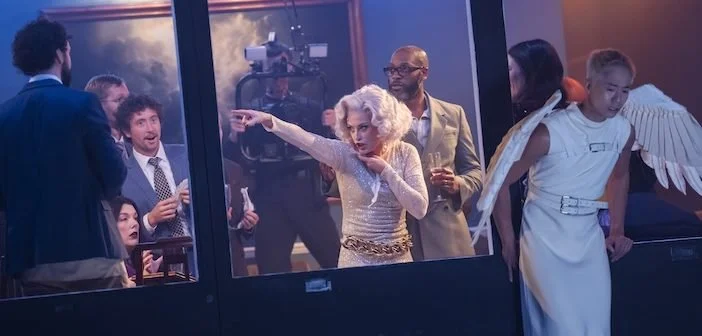
Angel’s Bone English National Opera 2026 ©Tristram Kenton
There are angels in the London Coliseum, but anyone expecting heavenly harmonies, celestial serenity and a little Handelian comfort should probably have checked the small print before taking their seats. Du Yun’s Angel’s Bone, with a libretto by Royce Vavrek, is a very different proposition: an unsettling, genre-defying work in which the celestial collides with the grotesquely human, and the discovery of two fallen angels becomes an appalling lesson in the exploitation of the vulnerable.
Winner of the 2017 Pulitzer Prize for Music, this is not an opera designed to send its audience home humming a favourite aria. Instead, it leaves one contemplating the darker corners of human nature, with the uncomfortable realisation that the monsters here wear perfectly ordinary clothes and might, in another setting, be our neighbours.
The premise is deceptively simple. Mr and Mrs X.E., a couple beset by financial difficulties and a marriage seemingly in terminal decline, discover two injured angels in their garden. What begins as an apparent act of kindness soon deteriorates into something altogether more sinister. The angels become commodities, their vulnerability exploited in the pursuit of money, fame and gratification. The wings may be heavenly, but the appetite of their captors is depressingly earthly.
Vavrek’s libretto makes no attempt to soften its subject. Human trafficking, modern slavery and sexual exploitation are not comfortable theatrical themes, and the work deliberately denies its audience the reassurance of a conventional operatic resolution. The disturbing power lies in the transformation of care into control, and compassion into cruelty. It is a chilling reminder that exploitation frequently begins with the language of opportunity and the pretence of benevolence.
Du Yun’s score refuses to sit politely within any single musical tradition. Opera, chamber music, cabaret, electronics and punk-inflected writing jostle for attention, occasionally producing moments of startling beauty before plunging the listener back into a more abrasive sound world. There are passages of almost sacred stillness, only for the atmosphere to be shattered by insistent rhythms and unsettling sonic textures.
It is a score that demands considerable flexibility from its performers, and conductor Baldur Brönnimann rises to the challenge, guiding the ENO Orchestra through the music’s abrupt changes of character and colour. The result is an accompaniment that can be lyrical one moment, confrontational the next, and deliberately uncomfortable when the drama demands it.
Not every stylistic juxtaposition necessarily convinces. At times, the musical ingredients threaten to compete rather than coalesce, and the sheer variety can make the work feel more like a succession of theatrical provocations than a continuously developing musical argument. Yet there is no mistaking Du Yun’s imaginative ambition. This is music that insists opera must be capable of confronting the present, rather than remaining comfortably ensconced in the nineteenth century.
Director Kip Williams, making his ENO and UK opera debut, brings a distinctive theatrical language to the production. Working with designer Marg Horwell, lighting designer Jack Knowles and video designer Ash J Woodward, he places technology at the heart of the storytelling.
Live video and projected close-ups create an intimacy that the vastness of the Coliseum might otherwise deny. Faces become landscapes of fear, calculation and suffering, while the camera’s gaze can make the audience feel uncomfortably complicit in the act of watching. The visual approach is particularly pertinent to a work concerned with the consumption of other people's suffering: the audience is not merely observing events, but is repeatedly invited to consider its own relationship with spectacle.
There is, inevitably, a danger that the technology becomes the event rather than the means of illuminating it. The tension between the live performers and their projected images occasionally threatens to distract from the underlying drama. Nevertheless, Williams demonstrates a clear understanding of the work’s central contradiction: these angels are simultaneously beings in need of protection and objects to be displayed, marketed and exploited.
The sound design, shared by Dominic Bilkey and Joseph Reiser, contributes to the deliberately immersive atmosphere, while the lighting reinforces the uneasy movement between the ordinary domestic world and the nightmare that unfolds within it. The production is visually ambitious, at times oppressive, and certainly not an evening for anyone seeking operatic escapism.
At the centre of the drama are Allison Cook as Mrs X.E. and Rodney Earl Clarke as Mr X.E., the couple whose apparent desperation gradually exposes something far more disturbing.
Cook is particularly well suited to a character whose outward respectability conceals a capacity for calculated cruelty. Her experience as a singing actress is valuable in a role that requires more than vocal accomplishment: Mrs X.E. must be persuasive as a human being before becoming horrifying as a perpetrator. Cook gives the character a disturbing theatrical presence, tracing the erosion of whatever moral restraint remains as the prospect of financial salvation takes hold.
Clarke provides a formidable counterpart as Mr X.E. His baritone and stage authority lend weight to a character whose behaviour is rooted in self-interest and entitlement. The danger is all the greater because the couple are not presented as supernatural villains. Their descent into exploitation is recognisably human, and Clarke helps to establish the uncomfortable normality from which their depravity emerges.
The two angels provide the emotional counterweight to this increasingly ugly domestic arrangement. Mariam Wallentin, making her ENO debut as Girl Angel, brings an intriguing cross-genre sensibility to the role. Known for her work with the experimental musical duo Wildbirds & Peacedrums, Wallentin is a performer whose artistic background sits naturally within Du Yun’s refusal to observe conventional boundaries. Her portrayal gives the Girl Angel a fragile, individual presence, helping to prevent the character from becoming merely a symbol of victimhood.
Matthew McKinney is especially compelling as Boy Angel. His tenor provides a striking contrast to the harsher musical environment, and the role calls for considerable stamina, emotional commitment and an ability to communicate vulnerability without tipping into sentimentality. McKinney brings an intensity to the character that anchors the drama, making the angel's suffering personal rather than abstract. His performance is among the production's most affecting elements, and a reminder that, however adventurous the staging, the human voice remains opera's most direct route to the heart.
Keith Pun completes the principal cast as Male Soprano, adding another distinctive vocal colour to this unusual musical landscape. The countertenor's contribution is particularly appropriate to a work that continually unsettles assumptions about vocal identity and operatic convention. Alongside the other performers, Pun helps sustain the production's strange, often disquieting atmosphere.
The Kantos Chamber Choir adds further texture to the musical fabric, while the ENO Orchestra provides the essential support for a score that moves restlessly between the familiar and the unexpected. Together, the musicians and singers meet the considerable demands of a work that requires them to inhabit several musical worlds within a single, concentrated dramatic experience.
At approximately 85 minutes without an interval, Angel’s Bone is a concentrated assault rather than an evening of conventional operatic indulgence. Its brevity does not make it an easy experience; indeed, the unbroken progression leaves little opportunity for the audience to draw breath or regain emotional distance.
There is a legitimate question about how much suffering a production must place before its audience before the impact begins to diminish. The unflinching treatment of exploitation is central to the opera's purpose, but provocation alone is not the same as dramatic development. At moments, the accumulation of disturbing imagery risks overwhelming the subtler questions of complicity, desperation and moral responsibility that make the story so troubling in the first place.
Yet the work's refusal to provide comfortable answers is also part of its strength. By placing the angels in a recognisably contemporary setting, Du Yun and Vavrek strip away the protective distance that mythology might otherwise provide. These are not simply celestial beings in distress; they represent the countless vulnerable individuals whose exploitation is enabled by greed, indifference and the willingness of others to look away.
For English National Opera, this is a bold choice of repertoire. It is not difficult to imagine audiences divided between those exhilarated by its theatrical inventiveness and those who find its musical eclecticism and unrelenting subject matter alienating. But a national opera company should not exist solely to provide familiar pleasures, and there is a compelling case for presenting works that challenge the boundaries of the art form.
Angel’s Bone may not convert every sceptic to contemporary opera, and its experimental score does not always make for comfortable listening. Nevertheless, the commitment of the cast, the ingenuity of the theatrical approach and the seriousness of the subject give the evening considerable force.
The angels may have fallen from heaven, but it is humanity that emerges most damaged. There are no easy absolutions here, no convenient happy ending and certainly no wings to carry the audience safely away from the consequences of what it has witnessed.
A provocative and unsettling piece of contemporary music theatre powerfully performed and visually ambitious. Not an easy night at the opera, but one that makes a persuasive case for opera as a living art form capable of confronting the darkest realities of the modern world.
David Buchler, Opera Spy