
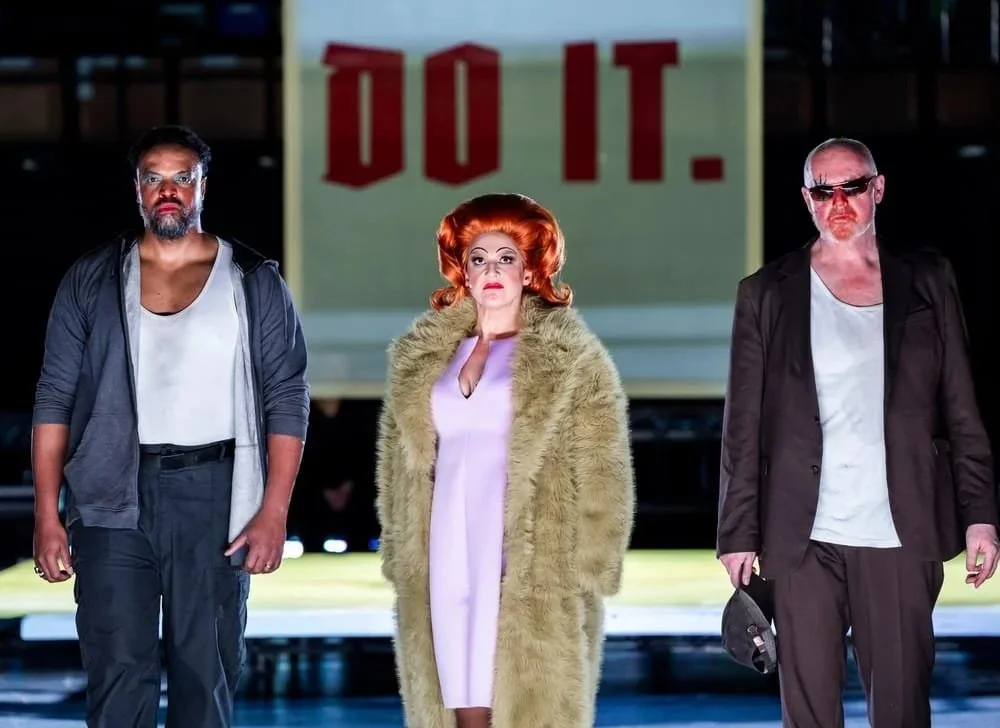
The Rise and Fall of the City of Mahagonny ENO 2026 ©Tristram Kenton
If opera is a battlefield, then English National Opera’s production of Rise and Fall of the City of Mahagonny on 16 February 2026 was combat with style — ragged, brassy, politically electric and full of enough theatrical bite to make a riot look tame. This was Mahagonny as if Brecht and Weill had sent protest postcards from our own tumultuous decade — and an announcement that the company’s future may just have a pulse again.
At the London Coliseum, where space can swallow subtlety whole, this new staging delivered a big, brash vision that seemed perfectly calibrated to challenge both performers and audience alike. Jamie Manton’s direction made no apologies for gritty storytelling: industrial signage, repurposed set pieces, and a chorus that attacked the ensemble numbers like a street gang on payday kept the drama taut and mercilessly present.
But if this Mahagonny had momentum, it was also clear that it was being steered by someone with a feverish understanding of Weill’s volatile score. André de Ridder, stepping onto the ENO podium as the incoming Music Director (designate), brought a rhythmic threat and raw orchestral energy that consistently pulled the production back from stylistic freefall. Where others might smooth and soften, de Ridder’s approach was to sharpen and let the music talk like jazz in a back-alley barfight — edgy, syncopated, and totally uncomfortably alive. De Ridder was willing to let Brecht’s cynicism live in the rhythms and Weill’s contradictions roar through every brass outcry. In a season when ENO’s identity has been much debated, his presence tonight felt less like a handbrake and more like ignition.
Vocally the night was anchored by powerhouse performances — the effervescent and mercurial Danielle de Niese as Jenny was a dazzling blend of theatrical glamour and emotional rupture, while Simon O’Neill’s Jimmy was as tragic as an opera tenor is legally allowed to be. Rosie Aldridge’s Begbick and Mark Le Brocq’s Fatty were supreme, and the rest of the ensemble danced like Brechtian marionettes with razor blades between their teeth.
Yet, Mahagonny is a beast that resists easy tames. In places the sprawling narrative sagged, and the vast Coliseum stage sometimes swallowed nuances that thrive in smaller houses. Its satire can feel as relentless as its score. But that relentlessness is also its strength: this was opera that did not want to be polite or pretty. It wanted to stick pins in its own libretto and watch the laughs bleed into thought.
A heady, combustible Mahagonny that feels utterly of our time — frightening, funny, occasionally flawed — but undeniably alive, and made all the more compelling under André de Ridder’s provocative musical leadership.
David Buchler, Opera Spy