
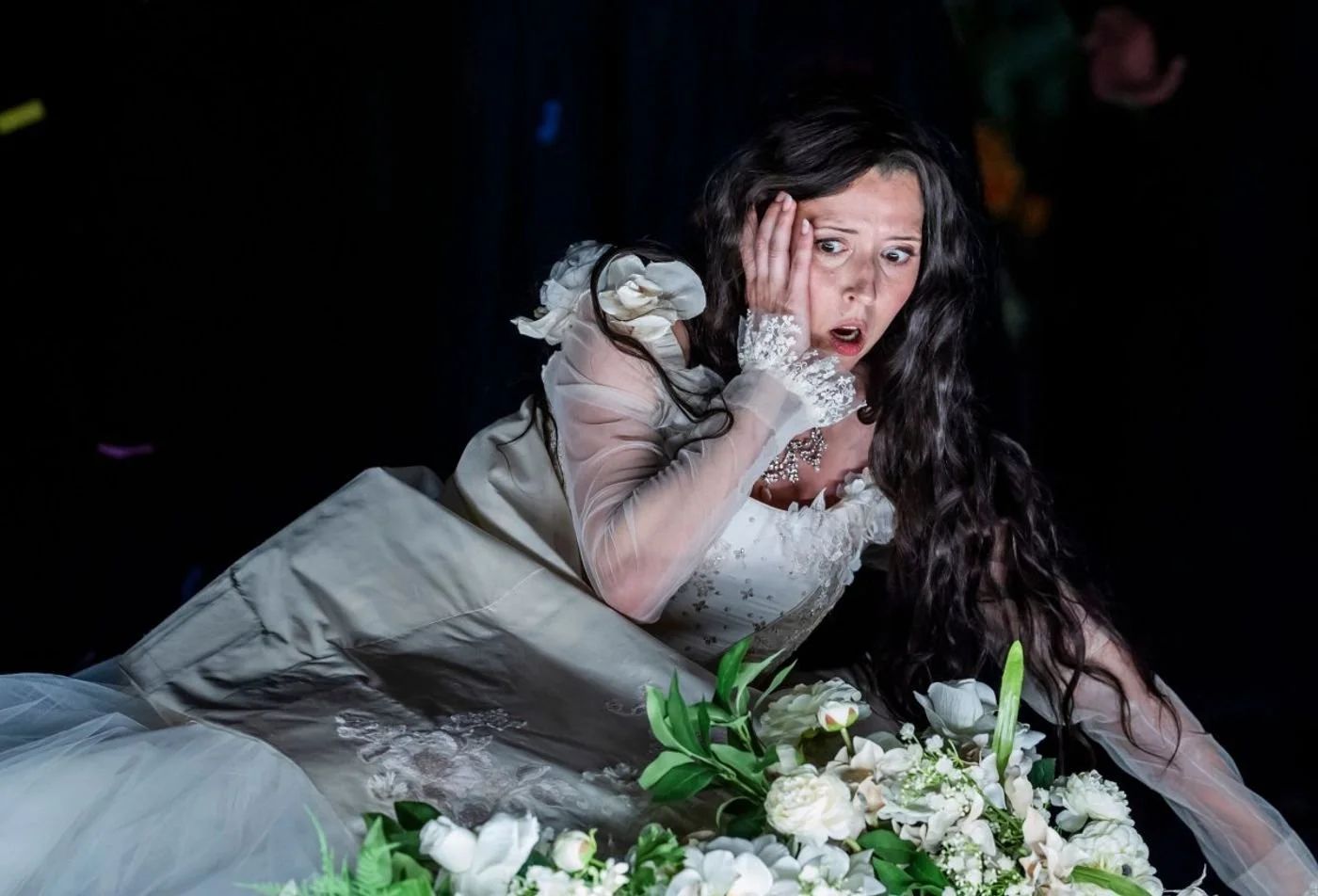
I Puritani Royal Ballet and Opera 2026 ©Tristram Kenton
Bellini's I Puritani is an opera that survives on the strength of its vocal writing. The plot, meanwhile, appears to have been assembled during a particularly long lunch involving too much claret and very little editorial oversight. Civil war, political prisoners, mistaken identities, sudden madness, miraculous recoveries and, naturally, everyone forgiving everyone else in the final five minutes. Bellini clearly knew where his priorities lay - and they certainly weren't with the librettist.
Fortunately, Sunday's matinee at Covent Garden reminded us why this gloriously implausible masterpiece continues to fill houses nearly two centuries later.
Richard Jones's typically grey production wisely resisted the increasingly fashionable temptation to explain everything. No contemporary political metaphors. No CCTV cameras. No psychiatric hospitals. No refugees trudging across the stage whilst Bellini's melodies pleaded for attention. Instead, Jones trusted the music, allowing Hyemi Shin's understated sets and Nicky Gillibrand's costumes to frame, rather than overwhelm, the drama. It proved an intelligent decision, because I Puritani lives or dies by its singers and not the numerous change of scenes.
And what singers.
As Elvira, Lisette Oropesa once again demonstrated why she has become one of today's undisputed queens of bel canto. The role asks almost everything of a soprano: crystalline coloratura, endless breath control, soaring top notes into the stratosphere and, above all, the ability to convince us that emotional fragility can be expressed through vocal virtuosity. Oropesa delivered all of it. Her mad scene was exquisitely judged, never descending into melodramatic excess, while every phrase was shaped with elegance and meaning. If there was a lesson in how Bellini should be sung, this was it.
Opposite her, Francesco Demuro tackled Arturo's notoriously unforgiving music with impressive assurance. Bellini clearly regarded the tenor voice as a high-wire act, and Demuro accepted the challenge without ever sacrificing musicality for sheer decibel count. His celebrated high notes emerged naturally rather than as circus tricks, and his lyrical singing in the love duets provided genuine warmth.
Andrzej Filończyk made Riccardo considerably more than the stock disappointed lover. His handsome baritone combined power with refinement, and his duet with Giorgio, "Suoni la tromba", generated one of the afternoon's biggest ovations. Alongside him, Ildebrando D'Arcangelo brought authority, gravitas and beautifully rounded tone to Sir Giorgio. Few basses today combine such vocal richness with such effortless stage presence, and his performance anchored the evening whenever Bellini's increasingly improbable plot threatened to drift into fantasy.
The smaller roles were equally well taken. Marcela Rahal brought quiet dignity to Enrichetta di Francia, while Blaise Malaba and Giorgi Guliashvili completed an exceptionally strong supporting cast with distinction.
The Royal Opera Chorus deserves particular praise. They are not merely decorative spectators in I Puritani but central to Bellini's dramatic architecture, and under chorus director William Spaulding they sang magnificently, combining thrilling weight with admirable precision.
In the pit, Riccardo Frizza started slowly and took some time to achieve the pace that this work demands. Bellini's orchestration has often been dismissed as sparse; in reality, it requires supreme discipline and sensitivity. Frizza understood instinctively when to let the orchestra breathe and when to propel the drama forward, never allowing the singers to be swamped. Long melodic lines unfolded naturally, the Royal Opera Orchestra responding with warmth, elegance and immaculate ensemble.
Visually, Jones's production served the score rather than competing with it. In an era when some directors appear determined to remind us how clever they are every thirty seconds, there was something refreshingly confident about allowing audiences simply to watch gifted singers perform glorious music. However, different shades of grey were the order of the day throughout.
Of course, I Puritani still asks us to believe that political revolution can be resolved almost as quickly as Elvira's mental collapse. But complaining about dramatic credibility in Bellini is rather like criticising champagne for being fizzy. One simply accepts the rules of engagement.
As the final ensemble swept gloriously towards its implausibly happy ending, the Covent Garden audience responded with a prolonged standing ovation that was richly deserved. Bellini may not have been opera's greatest dramatist, but in the hands of artists of this calibre, dramatic plausibility becomes almost irrelevant.
This was a reminder that great bel canto is not about vocal gymnastics alone. It is about line, style, elegance and emotional truth. On Sunday afternoon, the Royal Ballet and Opera had all four in abundance.
David Buchler, Opera Spy