
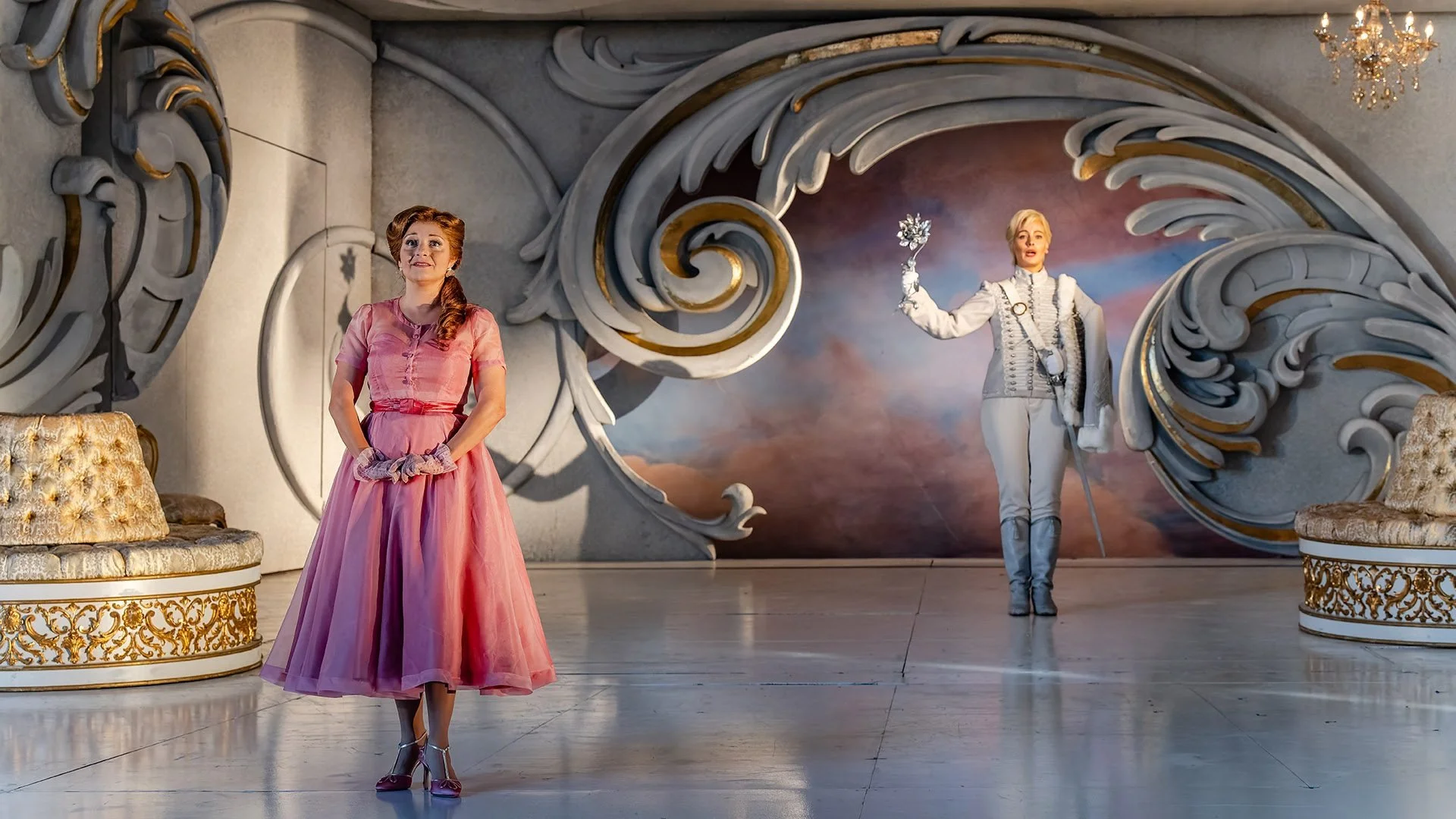
Der Rosenkavalier Garsington Opera 2026 ©Julian Guidera
There are some operas that seem perfectly designed for Garsington's idyllic setting. Der Rosenkavalier is one of them. The long dinner interval, the manicured Oxfordshire landscape and beautiful cricket pitch, and Strauss's luxuriant score all combine to create an experience that feels less like an evening at the opera and more like an extended stay in a particularly expensive Viennese dream.
Bruno Ravella's revival of his 2021 production returns looking every inch the luxury item. Gary McCann's designs place the action in a handsome post-war Vienna where aristocratic elegance is already beginning to fray at the edges. It's a production that understands that nostalgia is dangerous stuff: the silver (and the rose) gleams beautifully, but decay is never far away.
The emotional centre of the evening was the Marschallin of the Swedish soprano Matilda Sterby. Making her Garsington debut, she delivered a portrayal notable for its intelligence. The voice may not be the largest musical instrument, but it was deployed with unfailing musicality and a touching vulnerability. Her great Act I reflections emerged not as a diva's showpiece but as genuine self-examination. She made the Marschallin's acceptance of time's cruelty feel deeply human.
Opposite her, Niamh O'Sullivan the Irish mezzo-soprano singing Octavian was a considerable success. Possessing the kind of rich, warmly coloured mezzo that Strauss lovers dream about, she negotiated the role's awkward balancing act between impetuous adolescent and emerging adulthood with impressive conviction. Unlike some Octavians who appear to be permanently annoyed with everyone around them, O'Sullivan brought charm, humour and genuine erotic magnetism to her role.
The presentation of the silver rose remains one of opera's most miraculous scenes, and here it worked its magic largely because of the chemistry between O'Sullivan and the British-Iranian soprano Soraya Mafi's Sophie. Mafi sang with luminous tone and admirable freshness. Sophie's innocence can easily become insipid; Mafi avoided that trap, suggesting a young woman discovering her own strength beneath the porcelain exterior.
The evening's most divisive performance was German bass-baritone Andreas Bauer Kanabas as Baron Ochs. There is always a danger that Ochs becomes either a harmless buffoon or an irredeemable monster. Bauer Kanabas steered a middle course, presenting a boor whose self-confidence remains astonishing even as the world conspires against him. Vocally, the role sat comfortably within his ample bass, though there were moments when greater textual bite would have sharpened the characterisation.
Ben McAteer was a strongly sung Faninal, capturing both social ambition and parental anxiety, while Robert Murray and Siân Griffiths extracted every possible drop of comic value from Valzacchi and Annina without descending into caricature.
In the pit, Finnegan Downie Dear presided over a distinguished account of Strauss's score. Conductors can sometimes treat Rosenkavalier as an excuse for orchestral indulgence, allowing the Philharmonia Orchestra to wallow luxuriantly in every phrase. Downie Dear preferred clarity to excess. Tempi generally moved forward purposefully, inner details emerged cleanly, and the singers were supported rather than overwhelmed. The famous waltzes swayed with elegance rather than vulgarity.
Not everything landed perfectly. Act III remains a structural challenge that even the finest productions struggle to disguise. The farcical machinery occasionally felt overextended, and one sensed a slight dip in dramatic tension before the arrival of the Marschallin restored equilibrium. But these are minor reservations in a performance that understood the opera's essential balancing act between comedy and melancholy.
Ultimately, this revival succeeds because it never forgets what Hofmannsthal and Strauss knew from the start: Der Rosenkavalier is not really about romance. It is about time. About knowing when to let go. About recognising that grace in loss can be more moving than triumph in victory.
By the time the final female trio unfolded—one of the greatest ten minutes in all opera—the evening achieved something approaching transcendence. The audience sat in rapt silence before erupting into deserved applause.
Four years after its constrained pandemic-era unveiling, this Rosenkavalier finally feels like the grand Garsington success it was always meant to be.
David Buchler, Opera Spy

