
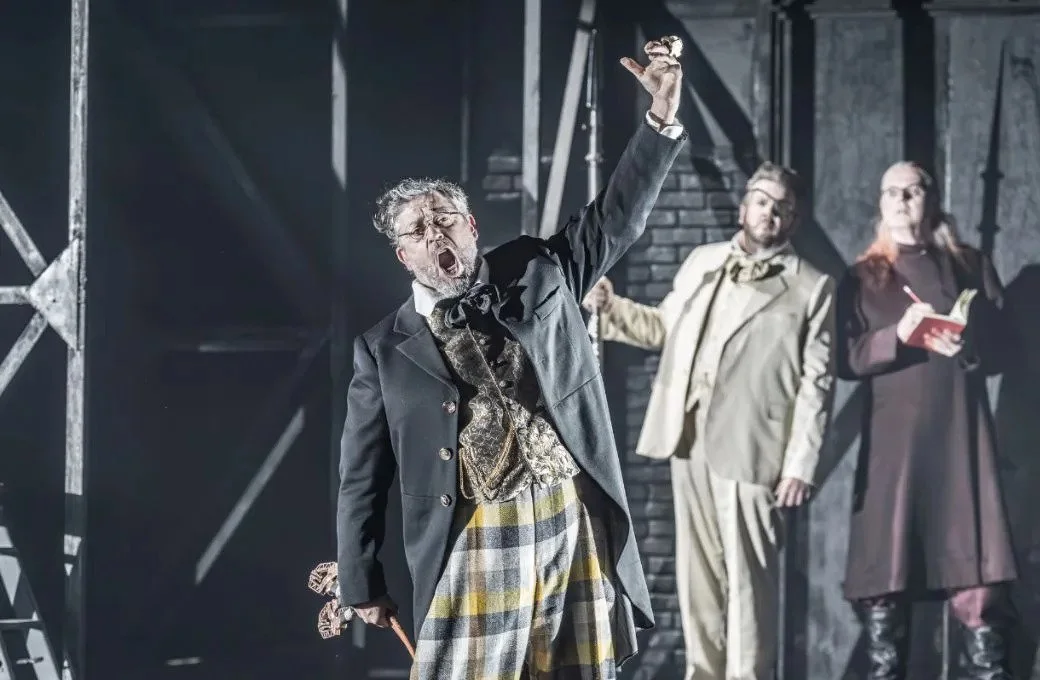
Das Rheingold Grange Park Opera 2026 ©Marc Brenner
There are productions of Das Rheingold that seek to overwhelm you with mythology, smoke machines and portentous symbolism. Grange Park Opera's new Rheingold does something rather more difficult: it trusts Wagner.
Charlie Edwards’s production is neither a museum piece nor an exercise in Regietheater self-indulgence. Instead, he presents Wagner's prologue as a remarkably clear drama about greed, power and broken promises. Strip away the gods, dwarfs and giants and you're left with a boardroom populated by politicians, oligarchs and bankers. Wagner was ahead of his time.
The famous opening emerged from the Orchestra of the English National Opera with extraordinary patience under Harry Sever, who paced the score with complete assurance. Wagner's seamless two-and-a-half hours can easily become static in the wrong hands but Sever allowed the music to breathe while never losing its inexorable momentum. The orchestral playing was magnificent: glowing brass, eloquent woodwind and strings that sustained Wagner's endless musical paragraphs with effortless poise. The leitmotifs appeared naturally, without ever feeling underlined.
At the centre of the drama was David Stout's magnificent Alberich. This was no pantomime villain but a bitter outsider whose humiliation curdled into ruthless ambition. Stout charted that transformation with remarkable psychological detail, making the theft of the Rhinegold feel tragically inevitable. His curse on the Ring carried genuine menace and became the moral fulcrum of the evening.
Opposite him, James Rutherford offered a compelling Wotan, less omnipotent ruler than seasoned politician desperately trying to stay ahead of events that have already slipped beyond his control. Rutherford possesses the vocal authority the role demands, but more importantly he revealed the god's increasing unease as every bargain creates another impossible dilemma.
Christine Rice's Fricka was no nagging wife but an intelligent, formidable presence whose exchanges with Wotan suggested a marriage built on political necessity rather than romance. Every phrase carried weight and purpose.
As Loge, Mark Le Brocq almost stole the evening. Light on his feet, vocally incisive and blessed with impeccable comic timing, he slithered through the action with the knowing air of someone who understands that everyone else is playing a game they cannot possibly win. His was a beautifully judged performance—witty without ever becoming camp.
Rachel Nicholls brought warmth and dignity to Freia, ensuring she was much more than the object over which everyone bartered. The relationship between Matthew Rose's beautifully sung and unexpectedly sympathetic Fasolt and Freia became genuinely touching, making Fasolt's murder even more shocking. Rose found remarkable humanity in the giant, while David Shipley's implacable Fafner was greed personified, coldly practical from beginning to end.
Thomas Isherwood made an imposing Donner, dispatching his famous summons to the storm with ringing authority, while James Schouten's elegant Froh supplied welcome lyricism among the gods.
As Mime, Adrian Thompson demonstrated once again why there are few finer singing actors on the British stage, creating a vividly characterised performance that never descended into caricature despite the role's relative brevity.
The evening paused, almost literally, with the arrival of Sara Fulgoni's Erda who sang from the stalls. Her rich contralto seemed to rise from the depths of the earth itself, and her warning to Wotan stopped both the drama and the audience in their tracks. It was one of those moments when Wagner reminds us why he has no equal.
The Rhinemaidens - Ailish Tynan (Woglinde), Olivia Rose Tringham (Wellgunde) and Charlotte Bateman (Flosshilde) - opened the evening with beguiling freshness, their voices blending beautifully while creating an entirely believable world of carefree innocence, making Alberich's violation of that world all the more disturbing.
Visually, Edwards exercised admirable restraint. Rather than burying Wagner beneath elaborate concepts or excessive technology, he relied on intelligent stagecraft, atmospheric lighting from Tim Mitchell and elegant costumes by Gabrielle Dalton to tell the story with clarity. Every image served the drama rather than distracting from it.
The final procession into Valhalla ascending via a step ladder wisely avoided triumphalism. Wagner's glorious music tells us the gods have won, but the drama tells us they have merely postponed disaster. Edwards understood that contradiction perfectly. The rainbow bridge looked less like a symbol of hope than the entrance to an empire already beginning to crumble.
Grange Park Opera has launched its ambitious Ring cycle with confidence, intelligence and, perhaps most importantly, complete faith in Wagner's extraordinary drama. There are no gimmicks here, no desperate attempts to reinvent the masterpiece, merely first-rate storytelling supported by a cast of uniformly exceptional singing actors and orchestral playing of the highest calibre.
If Das Rheingold is the foundation stone of the Ring, Grange Park Opera has laid it with considerable distinction. The gold has been stolen, the contracts have been signed, the gods have taken possession of their expensive new property—and, as Wagner knew only too well, the bills have yet to arrive.
David Buchler, Opera Spy

