
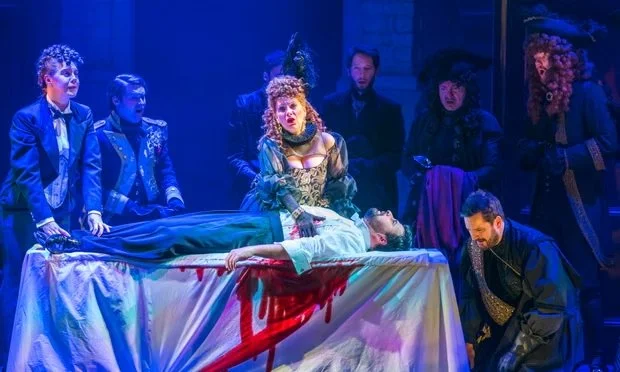
Un ballo in maschera Opera Holland Park 2026 ©Tristram Kenton
Opera Holland Park has long understood that Verdi thrives in the open air. There is something about the theatre's leafy setting that allows his music to breathe with uncommon freedom, and on the opening night of Un ballo in maschera the company revived Rodula Gaitanou's 2019 production with all the confidence of an old friend returning to tell a gripping story once more. If this was a revival, it certainly didn't feel like one. It felt alive.
Takis's handsome 1940s-inspired designs remain striking, shifting the action into a world of wartime glamour, political paranoia and moral ambiguity. It is a setting that suits Verdi's volatile mixture of romance and conspiracy remarkably well. The glitter of the masked ball only heightens the darkness gathering beneath the surface, while Gaitanou's direction never loses sight of the personal tragedy buried beneath the spectacle.
Despite an early announcement by James Clutton, the Opera Holland Park Chief Executive that the Italian tenor Matteo Desole was singing with a bad throat his King Gustavo was sung with effortless Italianate style and no shortage of vocal swagger. Desole possesses exactly the kind of bright, ringing tenor that makes Verdi's soaring phrases sound almost conversational. His opening music was delivered with infectious charm, while the great Act III farewell carried genuine pathos without descending into melodrama. There was steel in the voice when required, but equally an attractive sweetness that made Gustavo's fatal flaw entirely believable.
Opposite him, Elin Pritchard's Amelia proved a compelling emotional anchor. Her soprano combines warmth with gleaming top notes, and she charted Amelia's torment with admirable restraint. Rather than portraying a melodramatic heroine overwhelmed by circumstance, Pritchard created a woman desperately attempting to preserve dignity while her world collapsed around her. Her "Morrò, ma prima in grazia" was exquisitely shaped, the vocal line floating effortlessly before expanding into moments of thrilling dramatic power.
The evening's moral centre belonged to Dario Solari’s Count Anckarström, whose rich, virile baritone brought increasing emotional complexity to the betrayed husband. His transformation from loyal confidant to embittered conspirator unfolded with impressive psychological detail. The great aria "Eri tu" was one of the evening's musical high points: noble, bitter and heartbreakingly human.
One of the production's greatest strengths remains Rosalind Plowright's Madame Arvidson. Her commanding stage presence gives immediate authority to the fortune teller, and her richly coloured mezzo still carries tremendous dramatic weight. She avoided caricature entirely, creating a genuinely unsettling figure whose prophecy cast its shadow across everything that followed.
As Oscar, the page whose irrepressible energy constantly interrupts the gathering darkness, Rhian Lois brought sparkle and precision, delivering Verdi's brilliant coloratura with infectious ease and providing exactly the lightness the score requires without tipping into frivolity.
The supporting cast contributed strongly throughout, while the Opera Holland Park Chorus once again reminded audiences why it has become one of Britain's finest festival choruses. Whether depicting courtly celebrations or revolutionary fervour, their singing combined impressive precision with thrilling dramatic commitment.
In the pit, Michael Papadopoulos drew a performance from the City of London Sinfonia that balanced elegance with urgency. Verdi's score was allowed to sing naturally, never rushed for effect but always moving purposefully forward. The preludes shimmered, the ensembles crackled with dramatic tension, and the final masked ball built inexorably towards its devastating conclusion. The orchestra responded with playing of remarkable refinement, particularly from the woodwind and brass, whose contributions added colour without ever overwhelming the singers.
Opera Holland Park has built its reputation on presenting intelligent, musically distinguished productions that place storytelling before gimmickry, and Un ballo in maschera is another persuasive example of that philosophy. Gaitanou trusts Verdi, and Verdi repays that trust handsomely. The political intrigue remains gripping, the central love triangle genuinely affecting, and the final act retains its capacity to shock despite the familiarity of the plot.
The audience rewarded the company with an ovation that felt entirely earned. This revival demonstrates that great productions do not simply survive the passage of time—they mature. Nearly three decades after Un ballo in maschera closed Opera Holland Park's inaugural season in 1996, its return feels entirely fitting. Verdi's masterpiece has rarely seemed more at home beneath the canopy of Holland Park.
David Buchler, Opera Spy

