
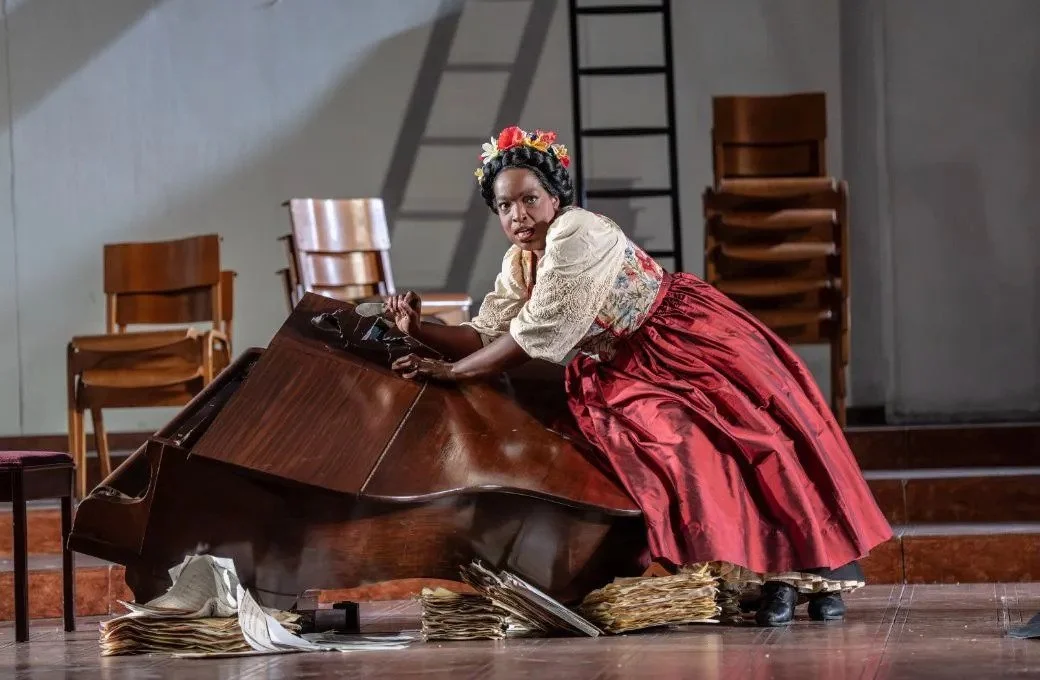
Tosca English National Opera 2026 ©Ellie Kurttz
There are few operas that can deliver quite the theatrical punch of Puccini’s Tosca. Murder, political intrigue, sexual obsession, torture, betrayal and ultimately suicide are all packed into a score of almost relentless dramatic intensity. It is a work that should leave an audience breathless, and ENO’s decision to include in its autumn season a brand-new production by Artistic Director Annilese Miskimmon was certainly an understandable undertaking.
Miskimmon transports the action from Napoleonic Rome to an unnamed Eastern European state in the 1980’s in a country undergoing civil strife and in the grip of authoritarian rule. The setting is a concert hall, a place supposedly devoted to musical and artistic expression but now threatened by the brutality of a regime determined to stamp out any form of cultural resistance. It is an interesting premise, particularly in an age when artistic freedom and political oppression remain uncomfortable bedfellows. The UK itself has seen its own form of cultural revolution with its Arts Council’s attempts to destroy the incredible operatic traditions of the past.
Rosanna Vize’s imposing designs provide an appropriately attractive backdrop. However, the once-grand concert hall becomes increasingly oppressive as the drama unfolds. Evie Gurney’s costumes and Lee Curran’s atmospheric lighting contribute to the sense of a society in which fear and intimidation have become part of everyday existence. The fear of the chorus and children at the end of Act I in the climatic Te Deum is palpable as the guards set about the praying congregation.
There is much to admire in Miskimmon’s determination to give this familiar masterpiece contemporary relevance. However, the relocation does not always work and the reinterpretation of the same set in three acts loses some of Puccini’s carefully constructed dramatic variety. However, the opera is still as relevant today as in the time of Mussolini’s fascism. Across the globe, from Russia to Iran, artists are being silenced for daring to speak out against oppressive regimes and Tosca goes to the heart of exactly this where artists and politics collide.
Musically, there was much to enjoy, not least the contribution of Ben Glassberg in the pit. He clearly understands the extraordinary sophistication of Puccini’s orchestration, drawing some beautifully judged playing from the Orchestra of ENO. The score was alive with colour and atmosphere, with the conductor demonstrating a fine appreciation of the contrasts between the music’s sweeping romanticism and its darker, more sinister passages. The orchestral writing was frequently the most persuasive argument for this opera.
In the title role, French soprano Axelle Fanyo made a moving impression. Tosca is a role that demands considerable vocal stamina, dramatic conviction and the ability to move effortlessly between tenderness, jealousy, anger and sheer desperation. Fanyo certainly brought an abundance of theatrical energy to the part. Her interpretation of the famous Act II aria Vissi d’arte was a particularly affecting moment, sensitively shaped and conveying the character’s bewilderment at the cruelty of her fate. There was a genuine emotional intensity to her performance, although the vocal line occasionally became less settled as the evening progressed. Nevertheless, she demonstrated considerable dramatic and vocal promise especially in her higher register in a role that is anything but straightforward.
As Mario Cavaradossi, Chaz’men Williams-Ali an American tenor had the unenviable task of following a long line of distinguished interpreters of one of the great tenor roles. His portrayal brought youthful enthusiasm to the painter and Tosca’s lover, although vocally the part presented some challenges. Puccini gives Cavaradossi two of the most glorious tenor arias in the repertoire, Recondita armonia and E lucevan le stelle, both requiring warmth, sustained lyricism and that unmistakable Italianate ring. Williams-Ali approached the music earnestly, but there were occasions when the voice lacked breadth and power. The romantic chemistry between the two protagonists should also have been more convincing, something that inevitably diminishes the emotional impact of the tragedy.
Christopher Purves, making his role debut as Baron Scarpia, brought considerable theatrical authority to the proceedings. Scarpia is one of opera’s great villains, a man whose appetite for power and sexual domination is matched only by his cruelty. Purves certainly understood the psychological dimensions of the character, creating a sinister and calculating presence without ever reaching a snarling unyielding intensity. His experience as a singing actor was evident in the way he manipulated those around him, although vocally his rather dry and speech-inflected approach did not always provide the dark, seductive richness one hopes for in this music. Scarpia should be as musically compelling as he is morally repellent, and this aspect of the performance was less consistently realised.
Among the supporting cast, Robert Hayward brought welcome character and experience to the role of the Sacristan, providing some much-needed humour in the opening act. Alaric Green made a strong contribution as Angelotti, while Osian Wyn Bowen and Steffan Lloyd Owen completed the supporting ensemble as Spoletta and Sciarrone respectively.
The Chorus of ENO also deserves recognition. Its contribution is particularly important in the opening act Te Deum, where Puccini creates one of the most extraordinary theatrical and musical moments in his entire repertoire. The children's chorus, drawn from Marlborough Primary School through ENO's community engagement programme, was a particularly welcome addition.
Ultimately, this Tosca is a production of considerable ambition. The idea of placing artistic expression under the shadow of political oppression is entirely legitimate. However, to be fair Puccini's masterpiece hardly needs additional theatrical complications to make its point. Its power lies in the extraordinary simplicity and brutality of its human story.
Tosca remains one of the great operatic thrillers, and it takes a particularly determined director to get in the way of its inherent dramatic power. This new ENO staging has moments of genuine theatrical impact, but it does not quite deliver the wholly compelling evening that this extraordinary score warrants. As with almost any new Tosca production, however, it will take time for all the ideas to settle.
A thought-provoking, occasionally frustrating, but musically rewarding opening to ENO’s Autumn season.
David Buchler, Opera Spy
