
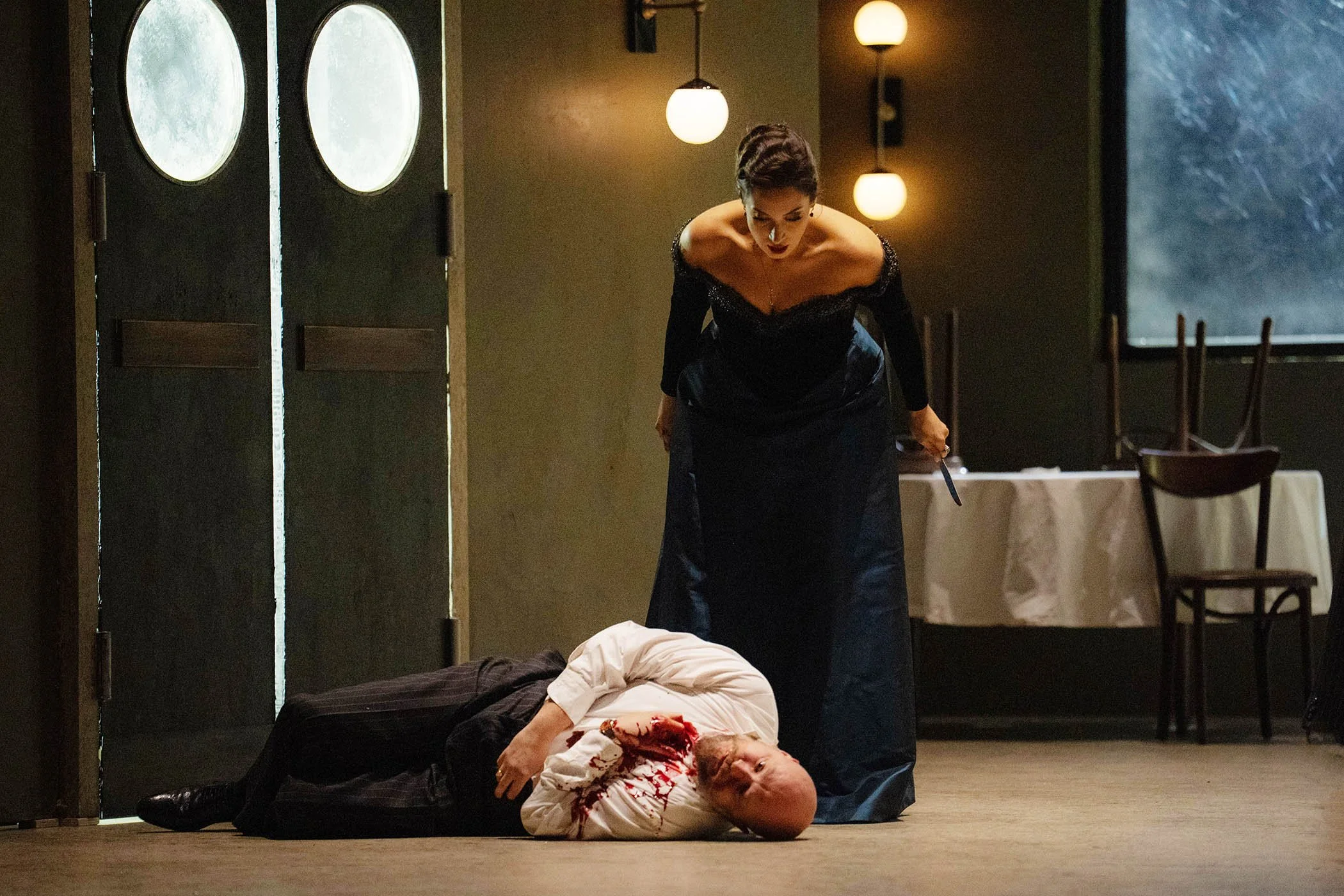
Tosca Glyndebourne 2026 ©Richard Hubert Smith
Glyndebourne’s new production of Tosca on 21 May 2026 arrived with a certain inevitability: Puccini’s Roman thriller, when placed in the coolly manicured Sussex setting, always risks feeling either thrillingly taut or oddly over-curated. This performance, mercifully, leaned toward the former—though not without moments where refinement threatened to sand down the opera’s bloodier edges.
From the first bars, the orchestra announced itself as a central protagonist. The conductor favoured a lithe, transparent reading over verismo heft, drawing out inner details often submerged beneath Puccini’s surging climaxes. Strings shimmered rather than sobbed; brass snarled with restraint rather than outright menace. It made for a Tosca less about raw brutality and more about psychological pressure—a slow tightening of the vice rather than a sudden snap.
The production itself—elegantly minimal, with architectural nods to Rome rather than literal reconstructions—played into this aesthetic. Clean lines, controlled lighting, and carefully composed tableaux gave the evening a sense of visual discipline. If you were looking for sweaty, candlelit Catholic excess, you might have found it a touch antiseptic. But dramatically, it allowed the performers’ interactions to come into sharper relief.
The Tosca of the American soprano Caitlin Gotimer was no mere diva-in-distress. This was a woman of intelligence and volatility, her jealousy in Act I flickering with genuine danger rather than coquettish irritation. Vocally, the role was handled with admirable control: a gleaming upper register, secure phrasing, and—crucially—the ability to scale the sound down without losing intensity. “Vissi d’arte” was delivered singing seated on her own not as a showpiece but as a moment of suspended disbelief, almost inward, the line spun with a fragile thread of sound that held the audience in rapt stillness. It wasn’t a heart-on-sleeve rendition, but it lingered.
Cavaradossi of the Italian tenor Matteo Lippi, by contrast, felt slightly less individual. The voice had the requisite Italianate warmth, and “Recondita armonia” was elegantly shaped, but there was a sense of caution in the performance, as though the singer never quite abandoned himself to the role’s impulsiveness. “E lucevan le stelle” was beautifully sung—phrased with care, floated pianissimi in all the right places—but emotionally it felt observed rather than lived. One admired it more than one felt undone by it.
It was Scarpia of the Russian baritone Vladislav Sulimsky who truly ignited the drama. Here, at last, was danger. The baritone brought a dark, focused tone and a chilling stillness to the role, resisting the temptation to bluster. His Act II was a masterclass in controlled menace: every gesture economical, every phrase weighted with implication. The Te Deum, often an excuse for vocal grandstanding, became something more insidious—a quiet assertion of power that grew all the more terrifying for its restraint.
The supporting roles were uniformly strong, with a particularly vivid Sacristan of Argentinian bass-baritone Federico De Michelis providing just enough comic relief without tipping into caricature. The chorus, as ever at Glyndebourne, was precise and polished, though perhaps a touch too refined for the scene’s supposed chaos.
If there was a lingering criticism, it lay in the production’s emotional temperature. Everything was beautifully judged, intelligently shaped, and musically satisfying—but occasionally one longed for a little more risk, a little more abandon. Tosca is, after all, an opera of extremes: love, lust, faith, cruelty. When those elements are slightly contained, the piece can feel more like an exquisite artefact than a visceral experience. And why at the end shoot Tosca when there are ramparts available for her to fall from!
Still, this was a Tosca of considerable musical integrity and dramatic intelligence. It may not have left the audience shattered, but it certainly left them thinking—and in a festival context that often prizes polish above all, that’s no small achievement.
David Buchler, Opera Spy