
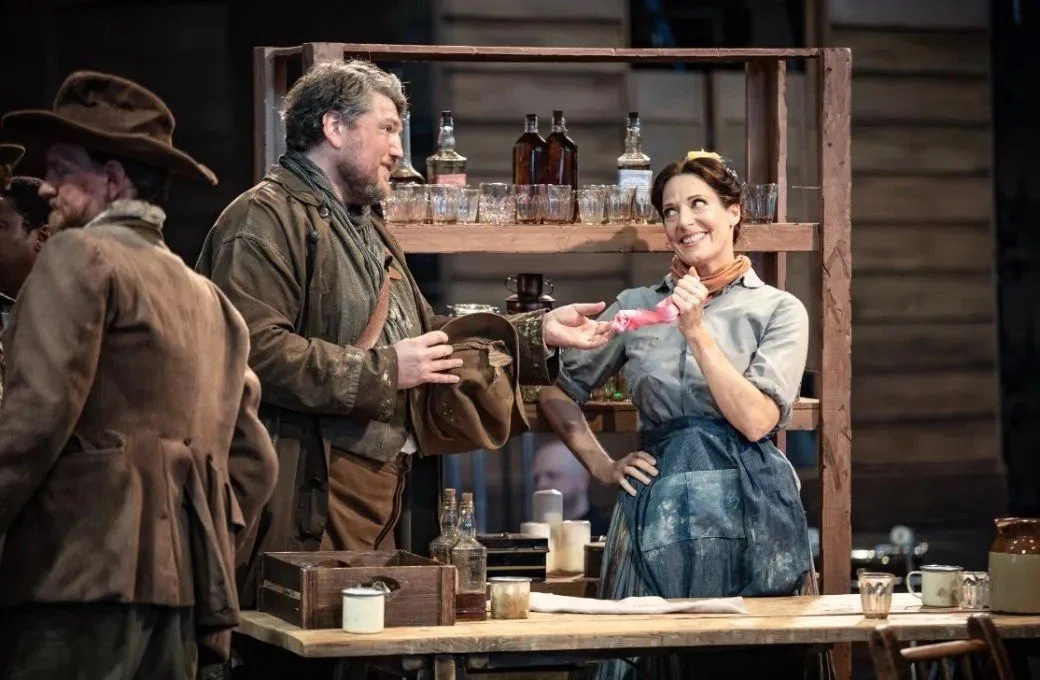
La fanciulla del West OHP 2026 ©Craig Fuller
At Opera Holland Park, Puccini’s La fanciulla del West opened the company’s 30th anniversary season not with a blaze of gold, but with a low-burning atmosphere of fatigue, desire and dust. On Tuesday 26 May, the great surprise was not that the evening worked, but that it worked so completely on its own terms. This is an opera often treated either as a proto-Hollywood curiosity or an overblown orchestral exercise in search of memorable tunes. Here, under director Martin Lloyd-Evans, it emerged as something tougher, stranger and considerably more moving.
The production wisely resisted the now almost compulsory temptation to “reimagine” the American West as a hedge fund conference, a Martian colony or a motorway service station. Anna Reid’s designs gave us timber, dust, snow and space — actual space — allowing Puccini’s lonely prospectors to look genuinely isolated rather than tastefully arranged. Holland Park’s wide stage can expose a production’s emptiness; here it became an expressive void into which homesickness and desperation leaked constantly.
What Lloyd-Evans understood is that Fanciulla lives or dies on ensemble atmosphere. The miners are not decorative chorus fodder but a damaged male community clinging to Minnie as priestess, schoolteacher, barmaid and unattainable fantasy. The opening scenes had exactly the right rough-edged energy: card games, brawling, horseplay and sudden silences whenever memory or desire intruded. One felt the influence of cinematic westerns without anyone laboriously signalling it.
Musically, conductor Matthew Kofi Waldren judged the score astutely. Puccini’s orchestration can easily turn into expensive soup, especially outdoors, but the City of London Sinfonia played with sinew and transparency. Details flickered out of the texture — banjo rhythms, uneasy harmonic shadows, little surges of Straussian ambition — without sacrificing momentum. The great Act Three build-up arrived with thrilling inevitability rather than mere decibel accumulation.
As Minnie, Amanda Echalaz gave the sort of performance that reminds one why casting matters more than concepts. She looked entirely plausible as a woman who could hold a saloon of unruly miners in line with a Bible in one hand and a rifle in the other. Vocally, there were moments when her somewhat difficult upper register tightened under pressure, but the sheer commitment of the portrayal carried everything before it. This was not a generic Puccini heroine in fancy boots; it was a portrait of emotional exhaustion held together by stubborn dignity. Her poker scene in Act Two gripped the audience with almost unbearable concentration.
Opposite her, José de Eça made an intelligent Dick Johnson. The voice is not the plush Italianate instrument of one’s fantasies, but he sang with increasing warmth and a welcome avoidance of slobbering verismo excess. His “Ch’ella mi creda” arrived honestly, which is rarer than it sounds. Too many tenors treat the aria as a gala concert encore parachuted into the opera from somewhere else. De Eça made it the desperate improvisation of a hunted man.
The evening’s dark centre, however, came from Robert Hayward as Jack Rance. Avoiding moustache-twirling villainy, he presented a sheriff corroded by entitlement and thwarted longing. Vocally firm and dramatically controlled, he charted Rance’s slide from swagger to humiliation with chilling clarity. One particularly admired the restraint: no barking, no chewing of scenery, no assumption that loud equals dangerous.
Around the principals, Opera Holland Park fielded one of the strongest supporting ensembles heard there in recent seasons. Blaise Malaba’s Jake Wallace stopped the show briefly with “Che faranno i vecchi miei”, sung with grave simplicity. The chorus scenes had genuine dramatic weight, especially once the mob mentality curdled in the final act.
There were flaws. The first act took time to settle, and the open-air acoustic occasionally swallowed conversational detail. A few moments of stage business looked under-rehearsed on opening night. Yet these seemed trivial beside the production’s larger achievement: persuading the audience that La fanciulla del West is not a curiosity at all, but one of Puccini’s boldest and most psychologically modern scores.
Most companies programme Fanciulla dutifully, as though ticking off an important but faintly inconvenient item on the Puccini list. Opera Holland Park treated it as repertory worth fighting for. By the final curtain, one understood exactly why.
David Buchler, Opera Spy

