
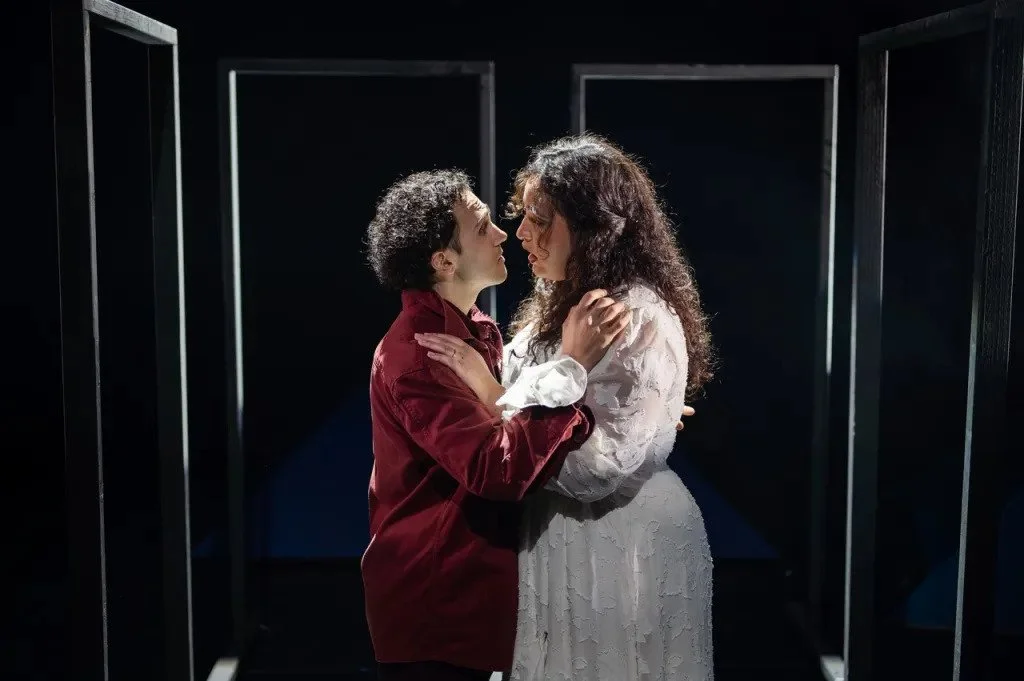
La sonnambula Hampstead Garden Opera 2026 ©Julian Guidera
Vincenzo Bellini’s La sonnambula is a rarely performed work that places enormous demands on its lead singers. Its delicate melodies, elaborate coloratura and seemingly endless vocal lines require not only technical accomplishment but an ability to communicate tenderness, vulnerability and emotional sincerity. It is therefore an ambitious undertaking for any opera company, but Hampstead Garden Opera (HGO) has once again demonstrated its commitment to giving emerging operatic talent the opportunity to shine.
John Wilkie’s production, at the intimate Jacksons Lane Theatre in Highgate, brings Bellini’s charming tale of love, jealousy, misunderstanding and eventual reconciliation to life with considerable affection. There is something particularly appropriate about presenting this work on a smaller scale, allowing the audience to feel close to the characters and the emotional complications that threaten the possible marriage between the lead cast members Amina and Elvino.
The story may be somewhat improbable, even by operatic standards, but Bellini’s glorious score ensures that one is more than willing to suspend disbelief. After all, how often does an opera offer so much romantic anguish and manage to reach a happy ending without anybody having to die?
In a small space the production is cleverly conceived by Wilkie, with Jennifer Gregory’s limited designs providing an abstract setting rather than attempting to recreate a conventional Alpine village. Moveable black metal frames and raised platforms create an interesting visual landscape, allowing the singers to move freely within the confined space. Jacob Gowler’s lighting adds atmosphere, although at times the staging could perhaps have benefited from a little more theatrical warmth.
HGO has assembled two outstanding casts, and the musical honours were very much in evidence, in the Wednesday performance which featured an impressive young cast.
Eyra Norman, an English Malaysian young soprano, was a particularly compelling Amina. Some of our greatest lyric sopranos have sung this role that can expose even the most accomplished, demanding seemingly effortless coloratura, immaculate control of the upper register and the ability to sustain Bellini’s long, arching melodic phrases. Norman demonstrated a real affinity for the music, producing a warm, expressive sound with some beautifully floated passages. Her vocal agility was impressive, but, more importantly, she brought considerable tenderness and vulnerability to the character. Her performance of Amina’s final scenes was especially affecting, allowing the emotional resolution to emerge naturally from the music.
As Elvino, Tobias Campos Santinaque provided a musically worthy and dramatically engaging partner. His attractive Italianate lyric tenor brought considerable energy to the role, and he captured the character’s jealousy and insecurity convincingly. Elvino is not always the most sympathetic of operatic lovers, particularly given his extraordinary willingness to doubt Amina, but Santinaque gave the character sufficient humanity to make his eventual reconciliation believable. His vocal approach was suitably athletic, although there were occasional moments when the upper register could have benefited from a little more freedom.
Hailey West was a lively and engaging Lisa. Her bright soprano and confident stage presence made her a convincing rival for Amina, and she brought a welcome touch of mischief to the proceedings. Lisa's music was delivered with considerable assurance, and West demonstrated a fine understanding of the bel canto style. There was also a pleasing theatrical intelligence in her portrayal, ensuring that Lisa was more than simply the other woman in this complicated romantic triangle.
The Swedish mezzo-soprano Mathilda Goike made a strong impression as Amina’s mother, Teresa. Although the role offers fewer opportunities for vocal display than the two other sopranos, Goike made the most of her appearances, providing a reassuring presence and a rich, well-projected vocal contribution. Her portrayal gave the production an important emotional anchor.
Michael Roche brought authority and a welcome sense of mystery to Count Rodolfo. His resonant bass-baritone gave the character the necessary gravitas, whilst his measured delivery provided a pleasing contrast to the emotional turbulence surrounding him. Ted Day was an appealing Alessio, bringing warmth and good humour to a character who is rather unfairly destined to remain on the sidelines of Lisa’s affections.
The musical direction on this occasion was in the hands of James Gillett, the assistant conductor, who took a caring baton for the 11 November performance. Bellini’s music requires considerable sensitivity from the conductor, particularly in allowing the singers the freedom to shape those long, exquisite melodic lines without sacrificing momentum. The reduced orchestration, with thirteen players including its individual string, wind and brass players, provided an interesting chamber interpretation of the score. Whilst this inevitably sacrifices some of the grandeur of a full operatic orchestra, it allowed the musical detail to come through and provided a sympathetic accompaniment to the singers.
The chorus of twelve also deserves recognition. They were energetic and committed, providing an effective backdrop to the unfolding drama and contributing considerably to the atmosphere of the village community.
Ultimately, La sonnambula is an opera that lives or dies by the quality of its Amina, and HGO has been fortunate with its impeccable casting.
HGO is to be congratulated for taking on a work that is rarely encountered outside the major opera houses. There are inevitably compromises when presenting such a vocally ambitious piece in a small theatre, and the production occasionally feels constrained by its surroundings. Nevertheless, the quality of the singing, the intelligence of the staging and the evident commitment of everyone involved made for a thoroughly enjoyable evening.
David Buchler, Opera Spy
