
PPO 2026 ©Cultural Center of the Philippines
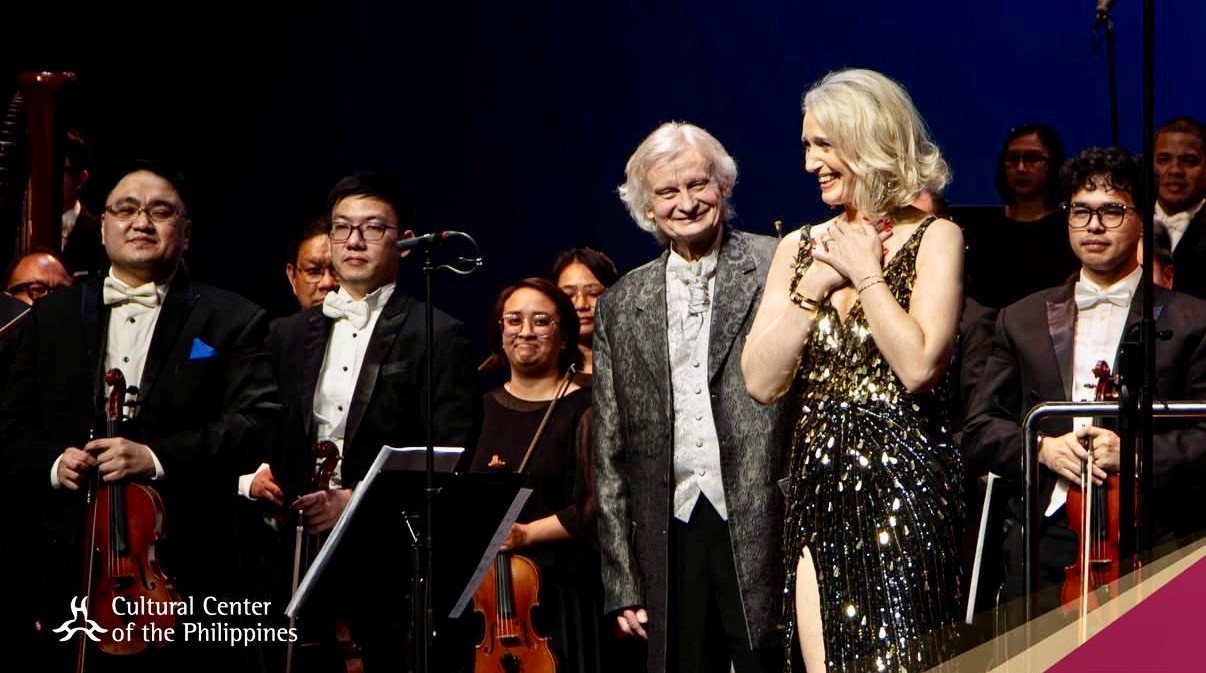
There was something quietly auspicious about Friday the 13th in Manila. It was a real sense of occasion with a hint of superstition. A world premiere was on the cards and with the Philippine Philharmonic Orchestra under the assured direction of conductor Grzegorz Nowak, and soprano Katerina Mina as the evening’s opening focal point, this “Opera” concert unfolded as a showcase of vocal command, stylistic intelligence, and distinguished by deeply felt musicality.
Richard Wagner only composed one complete symphony in 1832, but he never completed a symphony based on The Ring. Perhaps there was no need for him to do this because within the 15 hours of the most ambitious music written for The Ring of Nibelung there was probably embedded in the four operas several different symphonies. Jeffrey Ching who is the composer in residence of the Philippine Philharmonic Orchestra has provided an eighty-two-minute uninterrupted soundtrack of The Ring as a symphony. Blending, overlapping and reshaping all the main themes of Wagner’s Ring operas.
The unveiling of Ching’s Ring Symphony - a world premiere - added a sense of genuine occasion to the programme. Ambitious in scope and rich in orchestral colour, the piece allowed the orchestra to shine on its own terms. Nowak shaped the premiere with clarity and purpose, drawing out its structural coherence and giving the music space to register. The Philippine Philharmonic Orchestra responded with playing of polish and commitment, relishing the opportunity to introduce a new work with such conviction.
Together with this highlight the British Cypriot dramatic soprano, Katerina Mina, proved herself a compelling presence from the outset. Her voice - rich, focused, and gleaming through the upper register - carried effortlessly across the Metropolitan Theatre in Manila, but what distinguished her singing was the sense of complete control. She shaped phrases with patience and care, allowing lines to bloom naturally rather than forcing effect. There was an admirable confidence in her pacing: climaxes were built, not delivered, and the result was consistently satisfying.
In Verdi’s La forza del destino, she brought a poised intensity, the tone anchored yet flexible, with a luminous top that never lost its core. Her Pace, pace mio Dio unfolded with seamless legato and a finely judged emotional trajectory—elegant rather than overwrought yet undeniably moving.
The verismo repertoire suited her just as well. La mamma morta from Giordano’s opera Andrea Chénier was delivered with a strong sense of narrative, Mina drawing the listener in with a warm, communicative middle register before expanding into a radiant, full-bodied climax. There was a sense of inevitability to the arc—each phrase leading organically to the next.
Perhaps most impressive was her Vissi d’arte, which achieved a rare balance of simplicity and vocal polish. Mina resisted excess, instead offering a beautifully sustained line, supported by impeccable breath control. The result was both intimate and expansive, her tone floating with ease while remaining emotionally grounded.
The curiosity of the evening - Angel of Fire - suited her best of all. Written for her voice by Swiss composer Stephan Hodel on Mina’s own lyrics, this brilliant piece allowed Mina to lean into a darker, more contemporary palette, where text and timbre fuse into something closer to incantation than aria. Here, finally, the full personality emerged: intense, slightly dangerous, and entirely uninterested in operatic politeness.
Throughout, Nowak provided sensitive and attentive support. His conducting demonstrated a clear understanding of operatic phrasing, allowing the orchestra to breathe with the singer while maintaining structural clarity without ever letting the musical line sag. The Philippine Philharmonic Orchestra responded with refined playing—strings warm and cohesive, brass confident without overpowering, and woodwinds offering moments of delicate colour.
The overall impression was one of cohesion: singer, conductor, and orchestra aligned in purpose. Mina never felt imposed upon the programme; rather, she seemed fully integrated into the musical fabric of the evening, shaping and responding in equal measure.
What made the performance especially rewarding was its sense of assurance. This was an artist entirely at ease with her material, able to combine vocal brilliance with musical sensitivity. There was no need for exaggeration—just a confident, polished delivery that allowed the repertoire to speak clearly and directly.
By the final applause, any lingering thoughts of superstition had long disappeared. With the added distinction of a successful world premiere in Ching’s Ring Symphony, this was more than a concert—it was an evening of operatic and symphonic music-making at a very high level: elegant, accomplished, and wholly satisfying.
David Buchler, Opera Spy
