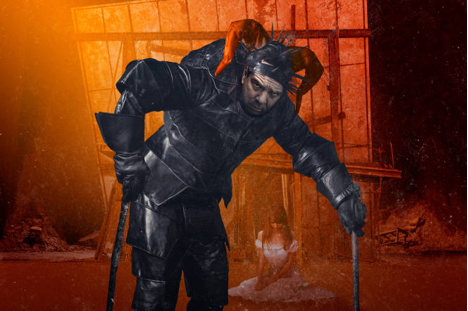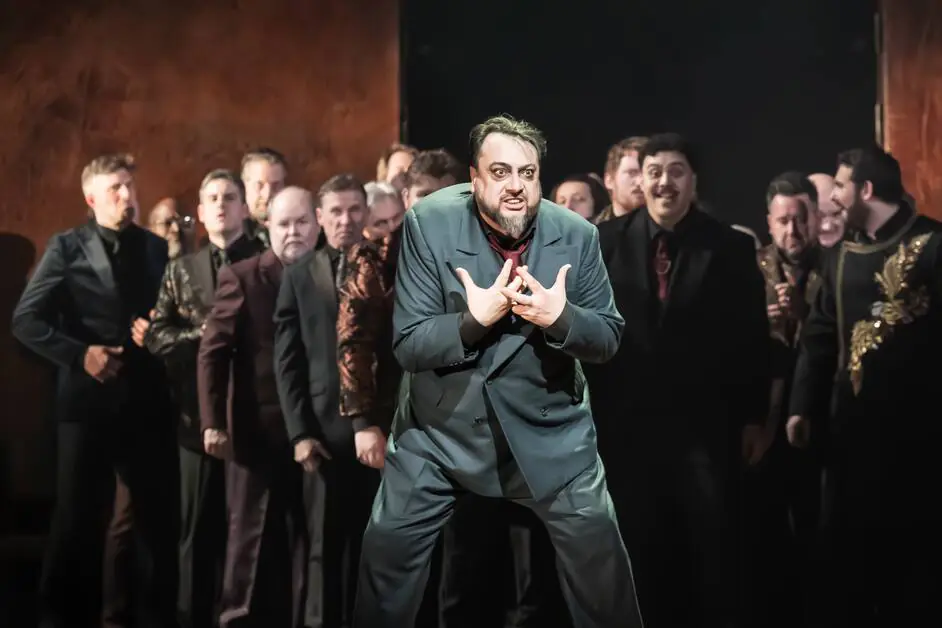
Rigoletto Royal Ballet and Opera 2026 ©Mark Brenner
There are revivals that feel like repertory staples, and there are revivals that sit in the throat like a bad conscience. Wednesday night’s Rigoletto at the Royal Opera House felt very much like the latter: sleek, intermittently gripping, occasionally exasperating, and still morally unpleasant in exactly the way Giuseppe Verdi intended.
Oliver Mears’ production remains a curious hybrid. It opens with visual assurance—decadence lacquered over rot, courtiers circling one another like bored predators—and then seems to lose confidence in its own ideas. The first act suggests a world; the second act gives us white walls, empty space, and people pacing as if the set had quietly been repossessed. It’s not new, but it is still frustrating: a production that promises a psychological study and delivers a half-finished abstraction.
Musically, however, the evening stands on firmer ground. Mark Elder conducts somewhat leisurely but with the quiet authority of someone who trusts the score more than the staging, and the orchestra responds with lean, unsentimental playing. There’s very little indulgence here: phrases breathe, recoil, and move forward with purpose. When it works, the pit feels less like accompaniment and more like the moral engine of the evening.
In the title role, Romanian baritone George Petean offers a Rigoletto of solid craft rather than corrosive danger. The voice is firm, the phrasing carefully controlled, and the paternal anguish entirely believable. What’s missing, though, is the sense of venom that makes the character truly uncomfortable. This is a Rigoletto who suffers; whether he is capable of inflicting real damage on the world around him feels less certain.
Opposite him, Russian lyric soprano Aida Garifullina is the emotional centre of the night as Gilda. The tone is bright and focused, almost glass-like in its purity, and “Caro nome” floats rather than lands. What impresses most is the restraint: this isn’t a sentimentalised victim but a thoughtful, attentive young woman who chooses rather than merely endures. By the final act, the tragedy feels earned rather than imposed.
As the Duke, Peruvian tenor Ivan Ayon-Rivas sings with enviable ease. The line is elegant, the high notes clean, and “La donna è mobile” glitters in precisely the way it should. What’s missing is danger. This Duke feels charming rather than predatory, and the opera needs him to be more unsettling than that.
The darker colours come from elsewhere. American mezzo-soprano Anne Marie Stanley gives Maddalena a grounded sensuality and a warmly plush tone, while British bass William Thomas brings a genuinely ominous stillness to Sparafucile. Together they anchor the final act, where the production finally rediscovers its nerve: stripped-back, brutal, and dramatically focused.
And that, perhaps, is the point. This Rigoletto works best when it stops trying to be clever and simply lets Verdi’s brutality speak for itself. Too often the staging hesitates between stylisation and realism and ends up doing both by halves. But the music—precise, relentless, and utterly unforgiving—keeps pulling it back to truth.
David Buchler, Opera Spy